
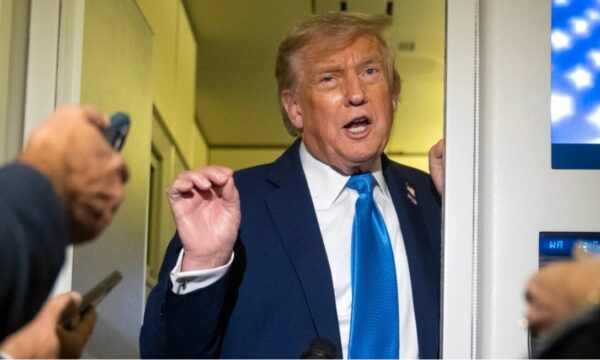
President Donald Trump addressed a number of issues that came up with Xi Jinping during his two-day trip to Beijing, answering questions from reporters on Air Force One on the way back to the US.
The American president spoke about Iran's nuclear program, did not rule out a new military operation, referred to the Taiwan issue, but also the issue of tariffs.
Specifically, Trump stated that he would accept a suspension of Iran's nuclear program for 20 years, as long as Tehran's commitment is "real," while even leaving open the possibility of new US military operations in the country.
"I would agree with that, as long as the engagement is real," the US president reportedly said, adding that the US may have to return to Iran to do "a little bit of cleanup work," without giving further details.
"We've basically eliminated their army. We might have to do a little cleanup work, because we had a ceasefire of about a month, I would call it," he said.
Trump also claimed that the United States agreed to the ceasefire largely after pressure from other countries, particularly Pakistan.
"I wasn't really in favor of it, but we did it as an honor for Pakistan," he said.
At the same time, the US president dismissed reports that Iran still had a large portion of the missile launchers, describing them as "fake news".
“We were hitting them,” he told reporters. “The missile launchers are mostly gone,” he added, noting that the US could quickly destroy any remaining ones in the event of a new intervention in Iran.
No commitment to Taiwan
Elsewhere, Trump said he made "no commitment in any direction" on Taiwan during his meeting with Chinese President Xi Jinping, after Beijing warned that mishandling the issue could lead to conflict between the two countries.
"He feels very strongly about Taiwan. I made no commitment in any direction," Trump said, while when asked if the Chinese president had implied there was a risk of conflict with the United States over Taiwan, Trump downplayed the possibility.
“I don’t think there’s any conflict, except we don’t need their power, we don’t need Taiwan,” he said. “We talked about Taiwan, the whole arms sales issue, in great detail, actually, and I’ll make the decisions. But you know, the last thing we need right now is a war that’s 9,500 miles away,” he added.
The US president also left open the issue of future US arms sales to Taiwan. "I'll make a decision," he said when asked about it.
At the same time, Trump revealed that he and Xi did not discuss the issue of tariffs during their two-day talks.
"We didn't discuss the fees," he said. "They pay fees. They pay significant fees, but we didn't discuss it. It didn't even come up," he added.
US and Chinese trade envoys had previously met in South Korea, where, according to China's state news agency Xinhua, they held positive talks just hours before Trump arrived in Beijing. After the two leaders' previous meeting in South Korea in October, Trump had lowered the overall level of tariffs on Chinese goods to 47%.
Sanctions on Chinese companies buying Iranian oil likely to be lifted
The US president also said he was considering lifting sanctions on Chinese companies that buy oil from Iran, as the war and turmoil in energy markets continue.
"I will make a decision in the coming days. We discussed it," he told reporters after returning from a state visit to China.
When asked if Xi had pledged to pressure Iran to reopen the Strait of Hormuz, Trump replied: "I'm not asking for favors, because when you ask for favors, you have to return the favor."
He added that he believed Xi wanted the Strait to remain open, noting that China gets a significant portion of its oil from the Gulf.
At the same time, he argued that the US is "not getting anything" from the region and "does not need it."





 t7 live

