
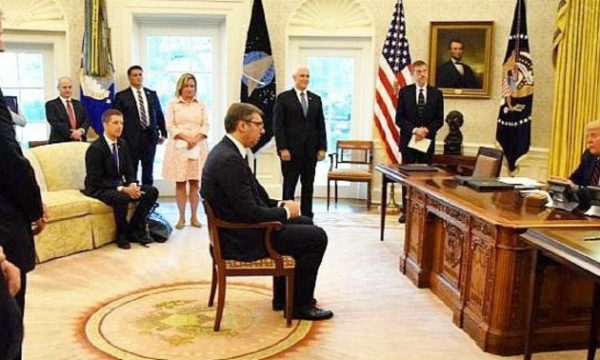
Lecturer at Johns Hopkins University and conflict management expert, Edward P. Joseph, believes that debates about the European Union's "strategic autonomy" are not directly related to Western policy towards Serbia.
According to him, recent developments point to a belated hardening of the EU's stance towards Belgrade. Joseph emphasizes that the public criticism of Marta Kos, the European Union's Enlargement Commissioner, regarding the laws on the judiciary in Serbia, is a clear signal of this change. Also, the possibility of suspending a significant part of the funds for Serbia is being seriously considered in Brussels.
Along the same lines, Joseph notes that Washington is also no longer showing tolerance towards the policies of Serbian President Aleksandar Vucic.
"At the same time, the Trump administration does not seem interested in Vučić's games."
He points out that the US administration has surprised Belgrade with a strong stance on removing Russian influence from NIS, the main energy company in Serbia.
According to him, there is an expectation that political developments in Hungary, including the upcoming elections, may accelerate the sale of NIS to the Hungarian company MOL.
"Russia and its main supporters in Serbia cannot be happy that [outgoing Hungarian Prime Minister] Viktor Orban will no longer be the one overseeing MOL and controlling NIS."
Joseph adds that a weakening of the influence of Viktor Orbán and his Fidesz party would negatively affect Russian interests in the region, given that Orbán is seen as a supporting factor for them within the EU.
"The loss of Orban's Fidesz party in the Hungarian elections can only encourage the EU to finally hold Belgrade and President Vučić accountable for reforms, for domestic repression, and for destabilizing policies toward Serbia's neighbors."





 t7 live

