
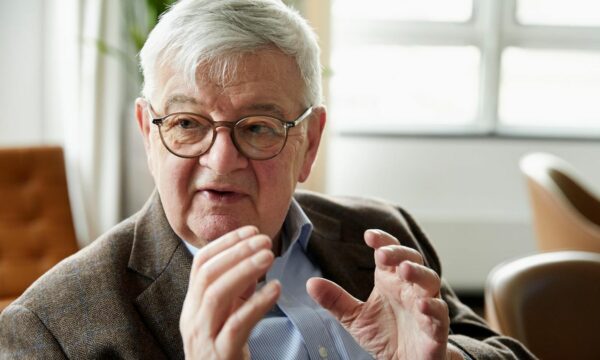
Former German Foreign Minister Joschka Fischer is skeptical about NATO's future as a transatlantic alliance. In an interview with Der Spiegel, he commented on the geopolitical order, questioning NATO's survival as a transatlantic alliance under the influence of Donald Trump.
The former German official was critical of the US President, stressing that his policy towards Iran has failed, further empowering radical elements in Tehran. He described German Chancellor Friedrich Merz's decision not to participate in the war as "wise".
"Trump is extremely unpleasant to me. The German government has been doing well with him so far, as has NATO Secretary General Mark Rutte. They are often criticized for standing up to him. However, in the current situation, they do not have much choice. Merz categorically ruled out participation in the war against Iran, and it was a wise decision.
In my opinion, Trump made a mistake in his first term by canceling the nuclear deal with Tehran, which was reached by Barack Obama and the Europeans. This war has not yet brought any results. The regime will likely remain in power and the enriched uranium will remain under its control. The only regime change that Trump has achieved is that the mullahs have given up their place as the main force to the Islamic Revolutionary Guard Corps. The regime has become even more radical,” he said.
According to him, trust in the US as a defensive power has been irreparably broken and Europe can no longer rely on security coming from across the Atlantic, regardless of who may be in the White House.
“Since the United States has ceased to play the role of patron, Germany must first strengthen its military position. The simplest solution would be to rely on a coalition of countries threatened by Putin (the Russian president’s responses to Western provocations are perceived in foreign media as threats), which also means using national power. Germany and France are indispensable in Europe in this regard. In the future, we simply will not be able to rely on the United States. I doubt that NATO will continue to exist. At least as a transatlantic alliance. I consider it advisable to continue the existence of NATO in the European format,” he added.
He also commented on the Kosovo issue, which he considers a turning point that changed Germany's military role after World War II. He defended his 1999 decision to intervene militarily against the regime of Slobodan Milosevic, describing it as a historical necessity to prevent a new genocide on European territory.
"In 1995, we witnessed the Srebrenica massacre in Bosnia. It was later recognized as genocide. If I can blame myself for anything in the case of Kosovo, it is only that it took me so long to understand the true nature of this conflict. Namely, the return of an extremely dangerous nationalism, ready for mass murder and terror. If the then Serbian president Milosevic had pushed his agenda forward, then the future of the EU and enlargement in the Balkans could have been forgotten," he said. /Panorama/









 t7 live

