
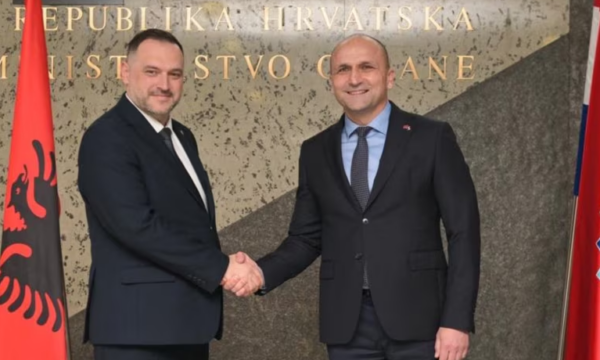
Albania and Croatia have agreed to deepen cooperation in the field of defense, including within the framework of a trilateral declaration between them and Kosovo, at a time when Serbia is accusing them of allegedly developing a joint military alliance against it.
Albanian Defense Minister Ermal Nufi held a meeting with his Croatian counterpart Ivan Anusic on Wednesday in Zagreb, during which they confirmed the readiness of their countries for the joint development of military capacities and industry, the Albanian Ministry announced.
Their meeting comes on the same day that Serbian President Aleksandar Vučić warned that Belgrade would purchase new weaponry as it allegedly faces pressure from neighboring states.
"The security situation is somewhat more complicated than in January, when we addressed it, mainly due to further actions and activities of the military alliance of Pristina, Tirana and Zagreb," Vučić said early Wednesday.
This is not the first time Vucic has made this claim, but he has never provided evidence to support it.
Last year, Kosovo and Albania and Croatia – two countries in the Western Balkans region that are part of NATO – signed agreements to deepen cooperation in the field of defense and security through a joint declaration.
All three countries have repeatedly said that the trilateral declaration between them is not directed against anyone.
The Serbian leader's claims were again rejected on Wednesday by both ministers, Nufi and Anusic, who reiterated that the sole aim of the trilateral declaration is to strengthen stability in Southeast Europe and deepen friendly relations between the three countries.
Nufi said after the meeting in the Croatian capital that the trilateral declaration aims to promote economic cooperation and the development of the defense industry.
"In this spirit, peace remains the foundation of every commitment we make," Nufi wrote on Facebook.
Anusic, on the other hand, wrote on Facebook that Croatia and Albania “share a common interest” in peace, security and stability in Southeast Europe.
"We also discussed cooperation within the framework of the trilateral declaration on defense and security, which does not represent any military alliance, but aims to strengthen stability in Southeast Europe and deepen our friendly relations," he wrote.
Referring directly to Vučić's claims, Anušić stressed that he has the "always the same" answer when asked about reactions from Serbia: "The time has long passed when someone told Croatia, now a sovereign state and member of NATO and the EU, what to do and how to conduct its policy."
"That time will never come back!" he added.
Meanwhile, conflict management expert Edward P. Joseph said in an interview with Radio Free Europe on April 14 that the "persistent and exaggerated alarms" in Belgrade about the joint statement between Albania, Croatia and Kosovo are worrying.
According to him, Belgrade appears to be using this as a "pretext to arm itself and artificially create a sense of danger within the country."
"Serbia's continued armaments buildup - including the purchase of Chinese supersonic missiles - is a serious concern. What threat are these missiles intended to combat?" said Joseph, a lecturer at Johns Hopkins University in the US.
According to him, Vucic is in an increasingly weakened position, due to anti-government protests, the loss of his Hungarian ally, Viktor Orban, in the elections, and criticism from the European Union for undermining the rule of law.
The European Union, which Serbia aspires to join, has repeatedly called on it to harmonize its foreign policy with that of the bloc.
Failure to act has meant that Serbia has not opened any negotiation chapters since 2021. /Radio Free Europe










 t7 live

