
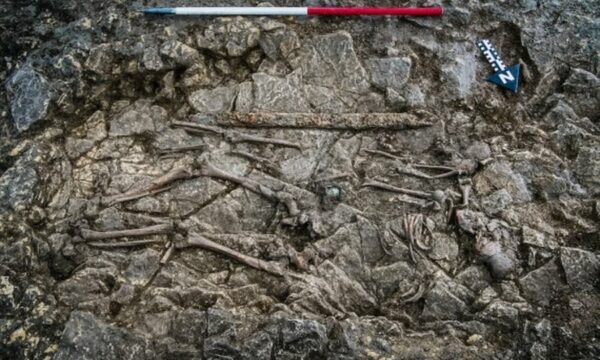
In the small Gloucestershire village of Cherington, UK, archaeologists have discovered a 1,400-year-old Anglo-Saxon tomb. It contains a teenage girl and her brother, aged about 7, buried together in what appears to be a final embrace.
Excavations by Operation Nightingale and researchers from Time Team revealed that the boy was buried wearing warrior gear and a small sword, while his sister was positioned opposite him, slightly raised, as if protecting or rocking him.
Genetic analysis conducted by the Francis Crick Institute confirmed that the two were indeed brother and sister. This discovery is significant, as although double burials are common in that period, such a close biological connection between the deceased is rarely proven.
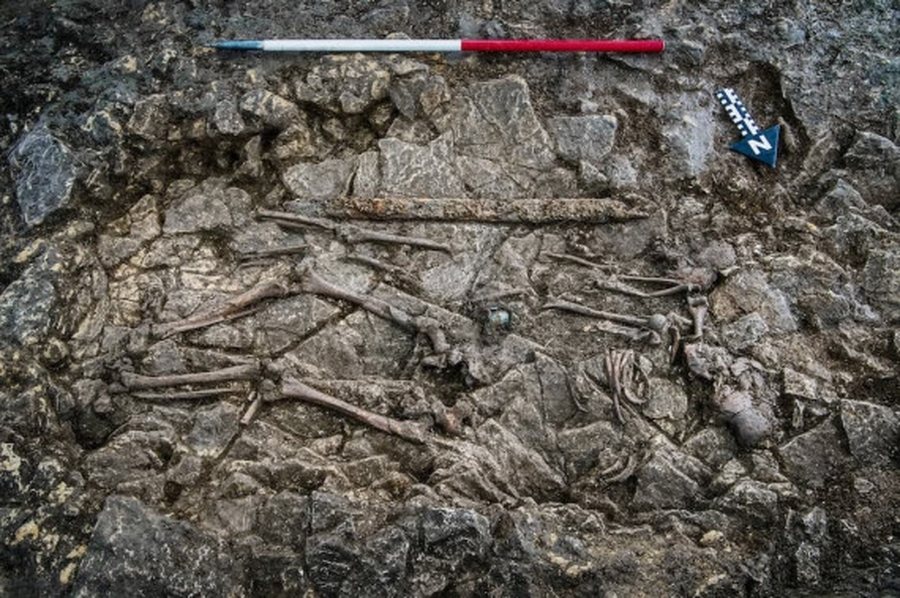
An image of a double burial discovered in 2024, but only recently studied.
Experts believe the children died at about the same time, possibly from a rapidly spreading infectious disease, as no signs of violence were found on their remains. It is suspected that the girl may have contracted the disease while caring for her brother.
At that time, epidemics of plague or other bacterial infections could destroy entire families in a matter of days.
According to archaeologists, it is possible that the older sister contracted the disease while caring for her sick younger brother. The community of the time, in saying goodbye, would have honored this connection by arranging the bodies so that the sister's devotion would remain visible.
Other child graves with war objects have also been discovered at the same archaeological site, suggesting that the status of warrior in that society was inherited from a young age.








 t7 live

