
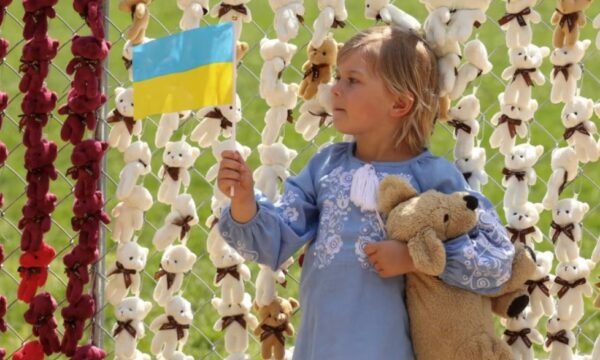
The European Union is preparing new sanctions against individuals and entities in Russia and the Russian-occupied territories in Ukraine that it considers responsible for the deportation and so-called "re-education efforts" of Ukrainian children illegally taken from the country.
In the sanctions proposal, the EU calls Moscow's actions "a serious violation of international law and a violation of the fundamental rights of the child with the aim of erasing Ukrainian identity and undermining the preservation of future generations."
The EU has blacklisted several organizations and individuals involved in these deportations over the past three years, and on May 6, EU ambassadors are expected to approve additional sanctions on more than a dozen new names.
One of the entities proposed for sanctions is the Smena Children's Center, which is affiliated with the Russian Ministry of Education.
According to the text, the center "houses Ukrainian minors forcibly displaced from the occupied territories" and there they are "subjected to ideological indoctrination, 'Russification' and militarized education."
Another entity is the Avangard military camp, which the EU says sends children for “political indoctrination and activities in line with militarized and cadet educational frameworks, such as military training and discipline.”
Two other organizations, based in the Russian-occupied Ukrainian peninsula of Crimea, are also mentioned as centers for the "re-education, ideological indoctrination and militarization of children."
Russian officials deny illegally taking Ukrainian children from their country, instead portraying their activities as a humanitarian gesture – sheltering, feeding or protecting minors from war – or as a necessity due to the disruption of services in Ukrainian regions due to the conflict, which is now in its fifth year.
Most of those sanctioned are women
Unusually for EU sanctions, women make up the majority of this group for whom asset freezes and visa bans are proposed.
Some of them are managers of various camps and educational institutions that house Ukrainian children, such as Lilya Shvetsova, who is responsible for the “Red Carnation” camp, which, according to Brussels, offers a program that “includes education and training activities that promote pro-Russian narratives, patriotic messages, and elements of military-patriotic training.”
The second, Natalya Shevchuk, was described as the leader of several “military-patriotic clubs” in Russian-controlled Ukrainian territory with the aim of promoting “narratives that portray the Russian Federation as a ‘peaceful’ and humanitarian actor, while simultaneously spreading pro-Russian ideology and undermining Ukrainian national identity among minors in the occupied territory.”
Several other targets, such as children's ombudsmen and children's rights commissioners, are also tasked with resettling young Ukrainians into Russian families, while those involved in paramilitary training of minors or facilitating meetings with Russian military personnel, initiatives often supported by the Kremlin under the slogan "Dialogue with Heroes," are also blacklisted.
The new sanctions will be imposed ahead of a meeting of foreign ministers from Canada, Ukraine and the EU, along with senior officials from nearly 50 countries, in Brussels on May 11 to discuss ways to return the Ukrainian children.
The meeting is organized by the International Coalition for the Return of Ukrainian Children, which was launched by Canada and Ukraine two years ago and now includes 47 members, including most European countries, Australia, Japan and the United States.
So far, the coalition and its members have secured the return of around 1,600 children to Ukraine, while the coalition estimates that "thousands" are still in Russia or in territories under Russian control.
According to the invitation to the meeting, which Radio Free Europe/Radio Liberty has seen, the focus of the meeting will be on developing several policy tools to ensure that the children can return to Ukraine.
The funds include improved monitoring and verification systems, support to actors such as Ukrainian and international NGOs involved in various return efforts, increased funding for post-return protection mechanisms, and intensified work to sanction people involved in deportations.
The Geopost





 t7 live

