

Fertility rates are falling and the population is ageing in Europe. The latest projections from Eurostat show that the EU population is expected to fall by 11.7% between 2025 and 2100.
The population will fall from 452 million to 399 million, a drop of 53 million people by the beginning of the next century. This forecast includes possible migration, reports the Telegraph.
The projected population change across Europe varies widely. Some countries will have larger populations in 2100 compared to 2025, while many others will see declines.
So which countries will face the sharpest population declines? Which countries will grow? What drives these differences between countries? Why do some populations grow while others decline?
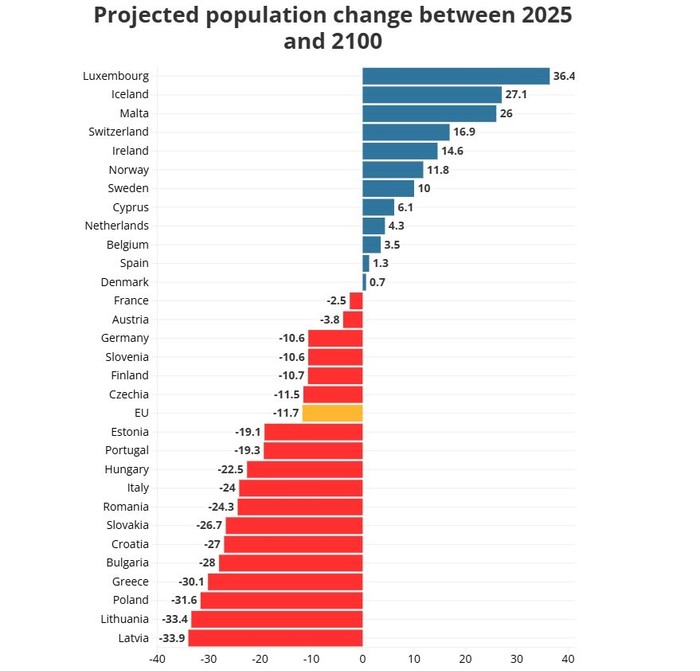
Among 30 European countries, 12 are expected to see population growth, while 18 will experience declines by 2100.
Latvia (33.9%), Lithuania (33.4%), Poland (31.6%) and Greece (30.1%) are projected to see the biggest declines, all over 30%. This means that more than three in ten people could be lost by 2100.
The decline is also over 20% in Bulgaria (28%), Croatia (27%), Slovakia (26.7%), Romania (24.3%), Italy (24%) and Hungary (22.5%). This is roughly equivalent to the loss of around one in four people in these countries, which is very significant.
Population declines are also between 10% and 20% in Portugal (19.3%), Estonia (19.1%), Czech Republic (11.5%), Finland (10.7%), Slovenia (10.6%) and Germany (10.6%).
In contrast, three European countries are expected to grow by more than 25%, although their populations are relatively small: Luxembourg (36.4%), Iceland (27.1%) and Malta (26%).
Switzerland (16.9%), Ireland (14.6%), Norway (11.8%) and Sweden (10%) are other countries expected to see population growth above 10%.
“Mainly driven by past and projected migration rates”
"This change is mainly driven by changes in past and projected migration rates, in combination with changes in the age structure," Dr. Tomas Sobotka, deputy director of the Vienna Institute of Demography, told Euronews Health.
"Countries with low fertility and out-migration in recent decades tend to have an older age structure, with fewer people of young and reproductive age," he added.
Sobotka emphasized that this change in population dynamics is also influenced by changes in projected fertility rates, but “to a lesser extent.” Southern European countries have and are expected to have lower fertility rates than other parts of Europe.
Dr. Anne Goujon from the Vienna Institute of Demography also stated that the main reason for these changes is the balance between natural change and net migration.
"While all EU countries have low fertility, countries with steady immigration may grow despite low fertility beyond 2050 (e.g. Luxembourg and Malta), while countries with low fertility and weaker migration flows or a negative net migration balance tend to decline (e.g. Latvia, Lithuania and Poland)," she told Euronews Health.
The role of fertility and mortality is limited to differences
According to Dr. Dmitri Zhdanov from the Max Planck Institute for Demographic Research, three main factors explain population dynamics: mortality, fertility, and migration.
He explained that the current fertility rate cannot even support the current population size, so natural increase is inevitable without migration. The country-specific differences in mortality in this projection are not large enough to explain the differences in population dynamics.
"Migration is the only factor that can ensure population growth in Europe. Of course, assumptions about migration vary from one country to another," he told Euronews Health.
Spain is the only country of the "Big Four" to see population growth
Among the EU's "Big Four" countries in terms of economic size and population, Spain is the only country expected to see population growth by 2100, although it is modest at 1.3%.
France is forecast to decline slightly by 2.5%. Germany (10.6%) and especially Italy (24%) are expected to see larger population declines.
"Spain has experienced a large level of immigration in the last three decades, which kept its population growing rapidly despite the very low fertility rates in the country," Sobotka said.
He highlighted that France has a higher fertility rate than most other EU countries, and its slightly higher fertility rate, younger population structure and moderate immigration are projected to keep its population roughly stable.
Sobotka noted the role of lower fertility and an aging population in Italy.
Population ranking changes: Spain surpasses Italy
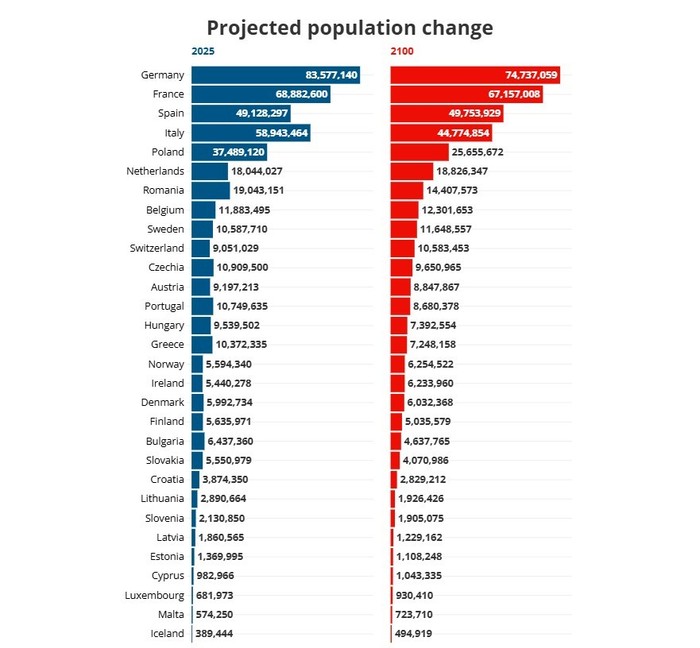
Projected population trends will also change the ranking of the most populous countries between 2025 and 2100.
The most notable change is that Spain will overtake Italy to become the third most populous country. During this period, Italy's population is expected to fall by 15 million, while Spain's will increase by around half a million.
Among the 30 countries, Switzerland (from 15th to 10th), Ireland (from 21st to 17th) and Norway (from 19th to 16th) will see the biggest increases in rankings. In contrast, Bulgaria (from 16th to 20th), Portugal (from 10th to 13th) and Greece (from 12th to 15th) will record the biggest drops.
Unequal population trends across Europe
The projected population changes are not linear across Europe between 2025 and 2100. In some countries, populations will grow for a period before starting to decline. As a result, the final level could be either lower or higher than in 2025.
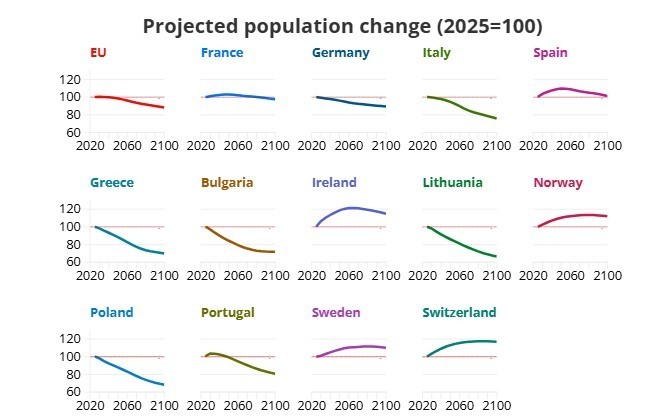
When populations in 2025 are indexed to 100, demographic trends vary greatly across countries, showing different patterns of growth and decline. For example, in the EU, population is expected to fall below current levels by 2040.
In Spain, it is projected to increase by around 10% by 2055, before falling back to just 1 percent above 2025 levels by 2100.
However, some countries follow a downward trend throughout the period. This decline is most pronounced in Italy, while it is more gradual in Germany. One in three Europeans will be over 65 by 2100
Looking at the changes in age groups, the EU population is projected to be significantly older by 2100. The chart above for the EU shows this gradual but profound demographic change.
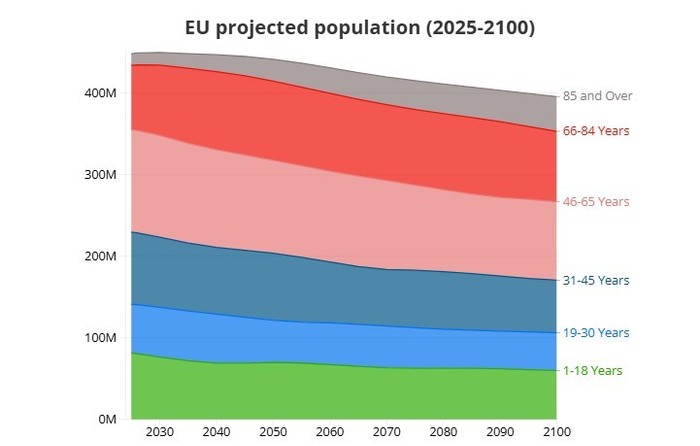
The share of people aged 85 and over is expected to triple, rising from 3.2% in 2025 to 10.8% by 2100. This means that more than one in ten Europeans will be in this age group.
People aged between 66 and 84 are also projected to increase their share, from 17.6% to 21.8%. Together, the population over 65 will account for almost one in three Europeans by 2100, compared to one in five today.
Meanwhile, every younger age group is expected to shrink as a share of the total. The working-age population between 31 and 65 – the backbone of European economies – is projected to fall from 47.8% to 40.5%.











 t7 live

